The $27 Billion Lock: Three Costly Mistakes International Food Exporters Make Trying to Crack Sweden’s Retail Monopoly
Episode 46. Start Global Insights – podcast for exporters.
Sweden’s food retail market represents an attractive prize for international exporters, valued at approximately €27 billion. This market is known for its main challenge: concentration. Just three players dominate roughly 90% of all food retail sales. To put this dominance into perspective, the largest player alone holds a 50% market share.
For any company dreaming of securing a listing and gaining access to this highly consolidated market, a straightforward approach is a recipe for failure.

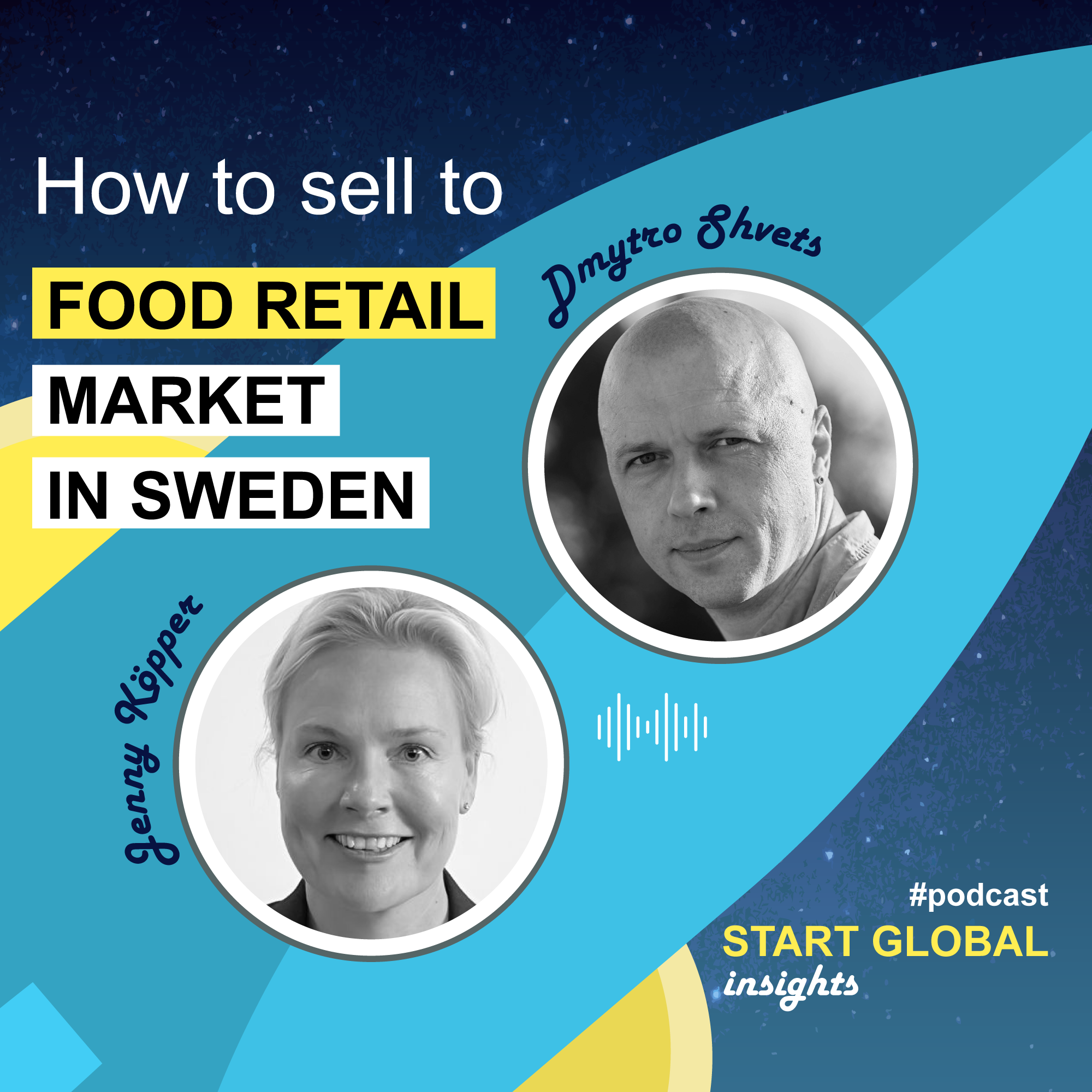
According to Jenny Köpper, CEO of Food Collective and an expert of the Swedish food industry with over 35 years of commercial experience—including positions of a category manager for major retailers —success does not come by luck. It comes from rigorous planning, empathy for the domestic partners, and avoiding three fundamental mistakes that derail most international expansion efforts.

Mistake 1: Falling for the “High Margin” Myth
The first mistake most exporters make is rooted in a fundamental misunderstanding of Sweden’s pricing structure. Companies often target the Swedish market because prices on the shelf are notably high, leading to the assumption that this translates to high profits and wide margins for suppliers.
“The price levels are not higher because we have more money,” Köpper explains. “The price levels are higher because it costs more to sell products in Sweden”.
The core issue is logistics and distribution. Sweden is a large country with a dispersed population (11 million people and 3,000 stores). The actual cost of handling and transportation is high when divided across these stores.
- The Reality Check: High shelf prices cover high distribution costs, not high supplier margins.
- The Calculation: Before approaching any partner, you must calculate backwards from the consumer price to ensure your product delivers the necessary profit. A supplier should calculate for a combined margin by multiplying the EXW price by two, though this varies by category.
Mistake 2: Approaching Buyers Without a Market Gap
The second mistake is the cold, undifferentiated approach. Buyers and category managers are under immense stress and receive thousands of proposals daily from around the world. Sending an email that “hopes for the best” without proper preparation is a waste of time.
Köpper stresses that the first step must be a highly detailed market analysis: “The first step is to identify a gap in the market“.
For a small producer—like the hypothetical candy business —the roadmap must prioritize the local partner:
- Find a Partner: Swedish retailers rarely import directly, preferring to work with importers or specialized distributors.
- Embrace the Niche: It is often more worthwhile to approach a smaller, niche distributor who is already the “winner in their niche” and can deliver larger specialized volumes, rather than starting with a major general wholesaler.
- Deliver Value: Your final, well-prepared presentation must clearly articulate your value proposition and demonstrate how your product helps the partner achieve their goals.
Mistake 3: Ignoring the Long-Term Time Horizon
The final, critical error is expecting fast results. The Swedish business culture, which heavily relies on networks and trust rather than cold outreach, dictates a lengthy sales process.
Köpper, whose own consultancy relied solely on her network for its first four years, advises that success in Sweden is built on established connections and a long-term plan. While trade shows can be effective for initial meetings to build “brand awareness”, they only initiate the process.
- The One-Year Rule: The process is “very long in Sweden”. “It rarely takes less than a year from first contact to first order“.
- The Sustainability Mandate: To be taken seriously, particularly for private label opportunities, suppliers must demonstrate commitment to modern Swedish values. Retailers actively compare suppliers based on their sustainability variables, including energy use, production, and transportation. Traceability to the product’s origin, including raw materials, is a necessity.
Listen the full episode on all major podcast platforms like Apple Podcasts, Spotify and YouTube Music and others.
Ultimately, the core summary for international success lies in strategic empathy. Success depends on understanding that your partners—the distributor and the retailer—have different needs than your end consumer. You must be able to position your company as a reliable, adaptable, and financially sound partner that allows them to earn more with you than without you