Selling food products in the European Union is one of the hardest things for a consumer packaged goods company to do. For businesses outside Europe, understanding EU food export regulations is not just about paperwork. It is also a hard fight against local companies that get financial support from their governments. The European dairy sector is especially well protected. To succeed, an exporter to the EU must adapt its product. It must make the product lighter, help it last longer, and make it a premium item.
This was the exact business challenge for snEco, a company that makes shelf-stable, 100% natural crunchy cheese snacks. By using new food technology and staying very focused on European rules, the company successfully entered several European Union markets. Today, their products are sold in Germany, Poland, Slovakia, and Sweden. Their story is a helpful guide for any business planning an international business expansion, even during very difficult times.
Start Global Insights: Global Sales, Local’s Expertise, Actionable Case Studies
Welcome to the Start Global Insights.
The business podcast for companies looking to expand globally.
On this show we interview experts from different countries to get insights about local business culture and help you to enter new global markets.
Let’s find together the answers to the questions:
How to prepare your business for international trade?
How to select proper focus markets?
How to get market insights and research new markets?
How to find proper local partner and start your sales?
How to start cross-border trade?
How to make your global trade consistent?
And many others…
Expanding a business internationally is about more than just crossing borders, it’s about understanding people, cultures, and the mechanics of complex sales.
Start Global Insights, hosted by Dmytro Shvets, is a dedicated resource for entrepreneurs, sales leaders, and business owners looking to scale globally. We move beyond generic advice to provide practical, expert-led intelligence on how to successfully enter new international markets and build sustainable B2B sales operations.
How We Help You Grow
This podcast serves as a high-level learning tool, offering deep dives into the strategies required to sell complex products and services in a globalized economy. We feature a variety of formats designed for the lifelong learner:
Local Market Blueprints: We decode the business landscape of specific regions, including Sweden, the Netherlands, Norway, Denmark, and many others, providing direct insights into local business etiquette, market structures, and entry roadmaps.
The Story of One Exporter: We go behind the scenes with founders and CEOs who share the real-world trials, errors, and breakthroughs of their expansion journeys. These case studies provide a tactical look at how diverse businesses crack foreign markets.
Strategic How-To Guides: Practical frameworks on the essentials of global trade, from choosing the right focus markets and conducting deep-dive research to international B2B lead generation and maximizing your ROI at trade shows.
Thematic Deep Dives: Specialist episodes exploring the nuances of international business, including interest-based negotiation (utilizing Harvard methodologies), cross-functional team synchronization, and the “Anatomy of Trust” in intercultural partnerships.
Insights from Global Experts
Every episode features professionals who have been on the front lines of international expansion:
Founders and CEOs of successfully globalized companies sharing their practical “on-the-ground” experience.
Global Sales Executives from multinational firms like Cisco and LeanIX discussing complex sales cycles and partner channels.
Academic Leaders and Specialists from institutions like Harvard and Stanford focusing on cross-cultural communication and negotiation.
Trade Officials and Consultants who reveal how to utilize open data and public resources to accelerate market entry.
Start Global Insights is for the professional who values practical skill acquisition and a deeper understanding of the global buyer’s journey.
Join us and gain the expertise needed to scale your business with confidence.
Find the Start Global Insights on all major podcast platforms or on YouTube https://www.youtube.com/@start-global
From NASA Tech to EU Shelves: How Ukrainian innovative food producer snEco entered the European Retail Market
byDmytro Shvets, Global markets expert, B2B Sales and Negotiations Expert
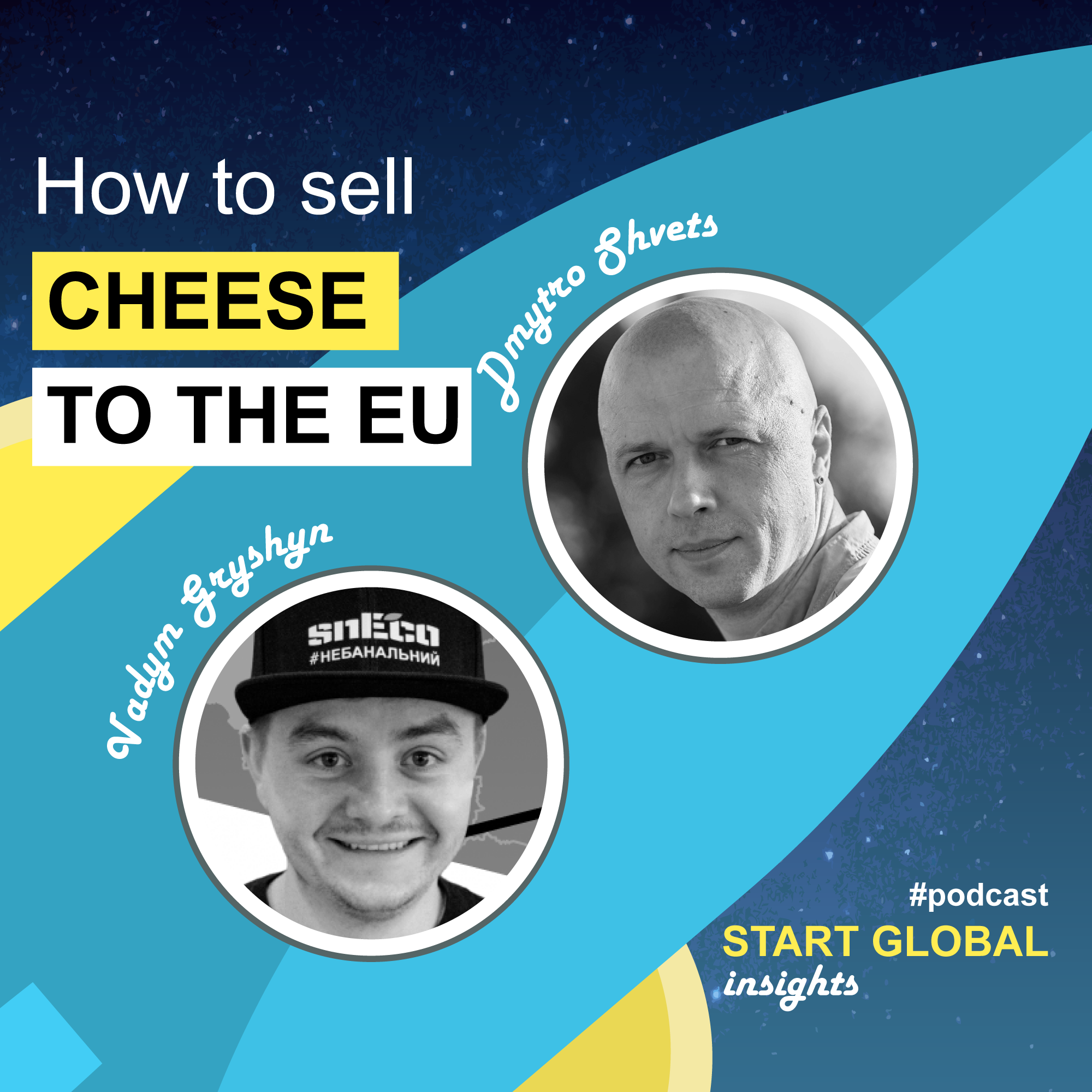
What does 1960s NASA technology and 100% natural crunchy cheese have in common? In this episode of Start Global Insights, host Dmytro Shvets sits down with Vadym Gryshyn, co-founder of the Ukrainian brand snEco.
Vadym shares the remarkable story of how he and his brother Philip built a patented food-tech business and navigated the highly strict EU regulatory systems to get their products on shelves across Germany, Poland, and Sweden.
What You’ll Learn in This Episode:
The NASA Connection: How snEco adapted NASA technology to create a 100% natural, shelf-stable cheese snack with a 24-month shelf life.
The EU “Traces” System: The complex process of becoming the first company in the region approved to export animal by-products to the EU.
The Danger of Non-Focus: Why attending international trade shows without a target market resulted in zero Spanish clients.
The Swedish Retail: Why Sweden’s decentralized supermarket model requires a completely different sales strategy compared to central-buying markets.
B2B Growth Hacks: Creative ways to get the attention of busy category managers and distributors.
The Nordic Timeline: Why you need patience, country-risk risk mitigation, and a 3-year horizon when selling to Northern Europe.
Episode Chapters & Timestamps:
00:00:23 Introduction to Vadym Gryshyn and snEco.
00:01:11 The origin story: Transitioning from non-food backgrounds to patented cheese tech.
Feedback: We value your thoughts. Please leave us a review on Apple podcasts, Spotify or email us at podcast@start-global.biz
Develop your international expansion strategy with Start Global
The Brand Story: Using Space-Age Food Technology
The story of snEco started in 2016 in the city of Kharkiv. Two brothers, serial entrepreneurs, Vadym and Philip Gryshyn, wanted to start a new business. They lacked prior experience in the food industry, but they both loved cheese and, since the beginning of the company, aimed to be present on global markets. However, they soon realized that cheese has a big physical problem. It has a short shelf life, big weight and it must be kept in a fridge during transport and storage. These requirements make transport very expensive and make it hard to sell cheese over long distances.
To solve this problem, the brothers looked for a way to make cheese last longer without a fridge. They studied different food preservation methods and found a solution in space exploration history.
In the late 1960s, the National Aeronautics and Space Administration (NASA) had a big problem. Sending food into space was very expensive because every kilogram of weight required a lot of rocket fuel. To solve this, scientists at the National Aeronautics and Space Administration created technologies like freeze- and microwave drying. These technologies removed all the water from the food to make it light, but kept the taste and nutrition.
The Gryshyn brothers adapted this idea and patented a technology called microwave vacuum drying. The result is a crunchy, shelf-stable cheese snack that can last for 24 months. It does not need a fridge, and it has no preservatives or artificial chemicals. By turning heavy cheese into a light, concentrated snack, the brand successfully solved the main logistics problems of cheese export.
“So step by step, we actually reinvented the technology, which we then patented, and now we are using it to produce the best in the world cheese snacks.”
Vadym Gryshyn
An Export Vision from the Beginning
The founders of snEco wanted to sell their product globally from the very first day. However, they knew they had to learn how the retail market worked in their home country first. They spent several years building their distribution network locally. They used this time to learn about supermarket sales, profit margins, and what retail buyers want.
This peaceful business development stopped suddenly when a full-scale war began. Kharkiv, where their factory was located, is in the east of the country and became a dangerous conflict area. The brothers had to act quickly to save their business and their team. They moved all their machines and relocated their entire factory to Mukachevo, a city on the western border. This new location was only 20 kilometers from Slovakia and Romania.
Building a new factory from scratch during a war was a massive challenge. But this move also gave them a strategic advantage. Their new manufacturing base was now right next to the European Union single market. This change of location made logistics much easier and reduced the transport times to European countries.
Testing Global Markets and Countries
Before spending a lot of money on international logistics, the company wanted to test if foreign customers actually liked their product. In the summer of 2024, they took their first steps outside their home market by displaying their products at the Warsaw Food Expo in Poland.
“The first step was actually to test the market, but not the market itself, but the buyers of the market.”
Vadym Gryshyn
For the founders, the main goal of this exhibition was not to sign a big business-to-business distributor agreement immediately. Instead, they wanted to get honest feedback from retail buyers and customers. Because their crunchy cheese was a completely new product category, they needed to see if people liked the taste, texture, and packaging. The feedback in Warsaw was excellent. This test proved that their product was suitable for European tastes, giving them the confidence to start the official registration process.
After their successful test in Poland, the founders made a common mistake. They tried to expand into too many countries at the same time. Without a clear export market entry strategy, they began to attend food exhibitions all over the world. They traveled to trade shows in Germany, Spain, France, Japan, and the United States.
Although buyers at these exhibitions liked the product, these trips did not lead to real sales contracts. For example, the company exhibited at the Salon Gourmets trade show in Spain. People loved the packaging and the taste, but the company did not get any customers in Spain, even after several years.
This taught the founders an important lesson: getting compliments at a trade show is not the same as making a sale. Every country has different laws, retail structures, and consumer habits. Trying to enter too many markets at the same time wastes money and stops a company from doing the deep follow-up work needed to sign a retail contract.
“The markets are different, cultures are different, the structure of the market is different in different countries.”
Vadym Gryshyn
Focusing on Countries and Entering the European Union
To fix this mistake, the founders changed their strategy. They realized they needed to focus on specific countries instead of trying to sell everywhere. They decided to target markets that were geographically close to their new factory. This made logistics cheaper and allowed them to manage their growth step-by-step.
By focusing their energy on a few neighboring countries, they began to secure regular sales. They started selling in Poland, Germany, Slovakia, and the Czech Republic. This focused approach allowed them to build strong relationships with local partners and learn how to manage international business expansion successfully.
Certification for the European Union and the TRACES System
To sell food products in Europe, a business must follow strict rules. Under European Union food law, any food made from animals, including milk, cheese, and other dairy products, must meet the highest safety standards. Passing these European Union import regulations and European Union trade regulations requires a lot of preparation.
The main system for these products is called the TRACES system of the European Union (Trade Control and Expert System). The European Union does not just look at product certificates. They keep a strict, official list of specific factories that are allowed to send animal products into Europe. If your factory is not on this official list, your products cannot pass European customs.
Getting this food export certification from the European Union took the company almost a year. They had to make many changes to their new factory to meet all the European Union food regulations and European Union animal by-product regulations.
Because of the war, inspectors from Europe could not travel to audit the factory in person. To solve this, the national government body, Derzhprodspozhyvsluzhba, helped them organize a virtual audit. The local inspectors wore body cameras and walked through the factory, streaming live video to the regulators in Europe. The European officials were satisfied with what they saw. Thanks to this creative solution, the factory became the first in its entire region to get the official registration to export dairy to the European Union single market.
“The European Union has a so-called TRACES system, which is a complete list of the producers who are allowed to import animal by-products to European countries.”
Vadym Gryshyn
Entering Sweden and Supporting Sales and Distribution
Even after getting all the necessary certifications, entering new countries is still difficult. The founders found that Sweden was their hardest market to enter.
In Sweden, individual store owners have a lot of power. Major supermarket groups, such as ICA Gruppen, hold a very large share of the Swedish grocery market. However, each individual supermarket manager decides what products to put on their shelves..
This means that signing a business-to-business distributor agreement with a Swedish importer is only the first step. The distributor’s sales team must physically visit hundreds of different stores across Sweden to show the product to each store manager. To help their Swedish distributor, snEco had to provide a lot of free samples and active point-of-sale marketing materials. This helped Swedish store managers understand the unique product and agree to try it on their shelves.
Business-to-Business Sales Channels and Creative Lead Generation
Because retail buyers and distributors get hundreds of sales emails every week, snEco had to find creative ways to get their attention. They use several main methods to find partners:
Professional LinkedIn Outreach:
They search for specific category managers at target retail chains and send them clear, professional, and personalized messages.
Matchmaking Events
They attend small, private business meetings where a small number of selected food producers can talk directly with invited retail buyers.
Physical Mail Campaigns
If a buyer does not reply on LinkedIn, the company packages their best product samples and mails them directly to the buyer’s office. They put the buyer’s exact name on the package. This physical package stands out and often starts the sales conversation.
Targeted Trade Exhibitions
They show their products at major food exhibitions. Instead of waiting for category managers to walk past their space, they identify target retail buyers before the event begins and invite them to their booth for a scheduled, face-to-face meeting.
snEco treats trade shows as “Strategic Battlegrounds.” They focus on the “Big Three”: Anuga (Germany), SIAL (France), and Gulfood (UAE), where roughly 90% of global retail buyers gather. The goal isn’t just to sell, it’s a cumulative demonstration of reliability. Buyers need to see you there the first year, the second year, and the third. They are looking for a partner who won’t disappear when a supply chain gets difficult or, in snEco’s case, when a war intensifies.
Final Advice to Exporters and Conclusion
The main lesson from snEco’s journey is that successful export requires absolute focus. Foreign business entry is a slow process that takes a lot of time.
“From the first meeting with the buyer, it usually takes three plus years to get the product, on the shelf”, Vadym Gryshyn
In Northern Europe and the Nordic countries, it can take up to three years of communication to get your product on the shelf. Exporters must be patient, stay consistent, and build deep personal trust with their partners over time.
By combining innovative technology with strong focus and persistence, any food brand can successfully navigate European Union food export regulations and build a profitable international business.
Subscribe to The Start Global Insights podcasts
Don’t miss the opportunity to get insights about business cultures of different countries. Subscribe to the Start Global Insights podcast on all major platforms, like Apple Podcasts, Spotify and YouTube Music.
FAQ: Food Export Regulations and Consumer Packaged Goods Distribution in the European Union Single Market
What is the TRACES system and why is it required for food export to Europe?
The TRACES system of the European Union is an online database used by the European Union to monitor all imports of animals, food, and plants. Under European Union food law, if your product contains ingredients of animal origin (like milk, butter, or cheese), your manufacturing facility must be audited and approved by the European Union. Once approved, your factory is listed in the TRACES database. If your facility is not registered in this system, European customs will reject your shipment, regardless of any other product certificates you have.
How does decentralized retail model affect an exporter’s strategy?
In centralized markets, a single contract with a head office category manager retail puts your product in all supermarkets. In a decentralized model, major chains, like e.g., ICA Gruppen, allow individual store managers to choose their own stock. Because of this, your business-to-business distributor agreement is only the start. You must actively support your distributor with samples and marketing materials so their sales representatives can win store-by-store listings across the country.
Why is a fragmented strategy approach to trade shows bad for consumer packaged goods brands?
Going to trade shows in many different countries at the same time dilutes your focus and wastes your budget. Every country has its own local consumer tastes, business culture, and food laws. Instead of trying to follow up on weak leads in five different countries, exporters should use a targeted export market entry strategy. It is much more efficient to focus on one or two high-priority countries and build strong, deep relationships there.
How can a foreign food exporter compete against subsidized European producers?
European dairy and agricultural sectors receive heavy financial support from their governments, making raw price competition very difficult. To compete, foreign brands must offer unique, premium products with high value-add.
How long does it take to secure retail distribution with Nordic retail buyers?
Entering the Nordic market is a slow process that usually takes three or more years from the first meeting to the actual product launch on supermarket shelves. Business cultures in countries like Sweden and Finland are very stable and risk-averse. Retail buyers plan their shelf changes far in advance and want to make sure you are a reliable, long-term partner. You must show strategic patience, attend multiple trade exhibitions to prove you are stable, and avoid aggressive sales pitches.
What’s one of the most important factor in winning B2B retail distribution deals in the EU single market?
Personal trust between the exporter and the buyer or distributor, built over repeated in-person meeting, particularly at trade shows, tends to matter more than product specifications alone, since buyers at major chains are ultimately assessing the supplier’s reliability as a long-term partner who can also navigate ongoing EU trade regulations.
What are the most effective business-to-business sales channels for food exporters entering the European Union?
According to snEco experience, food exporters can use several sales channels to find international partners. Professional outreach on professional networks like LinkedIn allows exporters to message targeted category managers directly. Small, private matchmaking events help pre-screened producers pitch directly to invited retail buyers in a private setting. Exhibiting at major trade shows is also highly effective if exporters research key buyers beforehand and schedule face-to-face appointments at their booths. Lastly, sending physical packages with customized sample boxes directly to category managers helps bypass digital noise and start sales conversations.
How should food exporters adapt their product packaging when entering different European Union markets?
Exporters must adapt their packaging sizes and designs to fit local expectations. For example, consumers in different regions prefer different serving sizes, so what works in one market might be too small or too large for European buyers. Additionally, exporters must be aware of country-of-origin sensitivities, as certain country names printed prominently on packaging can sometimes act as negative triggers for local buyers or retailers. Researching consumer perceptions before designing packaging is essential for securing placements in international retail chains.
What are the most common mistakes that new food exporters make when trying to go global?
According to snEco experience, The most common mistake is using a scattergun approach, which means trying to expand into too many countries at the same time without a strategic focus. Exporters often travel to trade shows worldwide and mistake polite compliments for actual sales intent, wasting limited financial resources in the process. Another major mistake is assuming that all markets operate with the exact same retail structures and consumer behavior. Success requires focusing on one target market and one unique product first, then slowly building distribution before expanding.