Mastering the Art of Negotiation in Ukraine: A Strategic Guide for International Leaders. Part 2.
Episode 51. Start Global Insights – podcast for exporters.
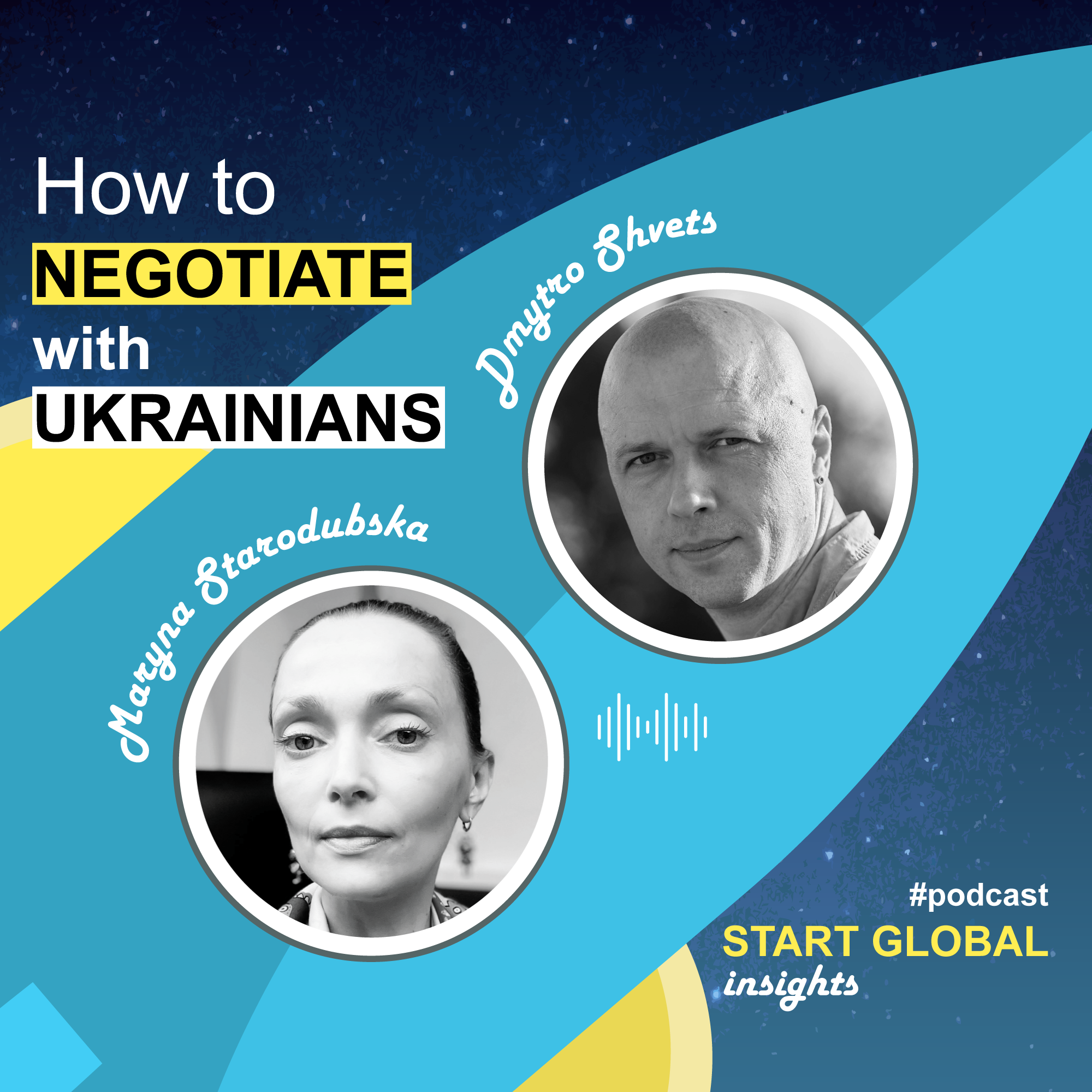
This article is based on Part 2 of the mini-series about Ukrainian business culture on the Start Global Insights podcast, featuring host Dmytro Shvets and expert Maryna Starodubska. Follow here for Part 1.
Building on our exploration of Ukraine culture, we move from the “why” to the “how.” For global executives and investors, the Ukrainian meeting room can be a place of significant friction or immense opportunity. Success in identifying and securing business opportunities in Ukraine depends on shifting from a “contract-first” mindset to a “relationship-first” strategy.
Based on the insights of cross-cultural expert Maryna Starodubska, this guide deconstructs the mechanics of making deals in the Ukrainian market.
Executive Summary for Global Leaders
- Personal vs business: Relationship first, contract second.
- Trust: Starts at zero; must be earned through “Trust Tests.”
- Communication: High-emotion and direct; bluntness equals sincerity.
- Negotiation Style: Often leans toward a competitive, zero-sum mindset.
Listen the full episode on all major podcast platforms like Apple Podcasts, Spotify and YouTube Music and others.

Understanding Ukraine Culture in Business
Negotiations are among the most culturally specific aspects of international expansion. In the context of Ukraine culture, the same words and actions that signal professionalism in Northern Europe can be perceived as offensive or ineffective. To successfully navigate business opportunities in Ukraine, leaders must understand that they aren’t just negotiating terms. they are navigating a complex landscape of earned trust and hybrid rules.

The “Hybrid” Approach to Contracts
There is a common joke in Ukraine: “The strictness of the law is compensated by the non-mandatory nature of compliance.”
When exploring business opportunities in Ukraine, you will encounter a “Hybrid” agreement style (common in Central/Eastern Europe). While there is deep respect for written obligations, primarily because the court system is a last resort, clauses are often interpreted with flexibility if the partnership is productive. In this culture, the contract is a “floor” (a minimum baseline), not a “ceiling.”
The Trust Deficit & “Trust Tests”
In many Western trustful societies, partners start with a “credit of trust.” In Ukraine, the trust account starts at zero. International partners often mistake this initial caution for hostility.
In reality, Ukrainians are running “trust tests.” They observe how you handle small requests and minor deadlines. Every promise delivered puts “money” into the trust account. Until that account is full, the legal contract carries very little weight.
Holistic vs. Problem-Oriented Bargaining
Western negotiators typically use problem-oriented bargaining: a granular, point-by-point discussion of every clause. For Ukrainians, this can be confusing.
Ukraine prefers holistic bargaining, which happens in two tracks:
Track 1: Decision-makers (Founders/CEOs) meet to agree on the big picture, red lines, and core principles.
Track 2: Once the “bosses” reach a verbal agreement, managers and lawyers handle the granular details. Mixing these tracks is a common reason why promising business opportunities in Ukraine may fail to materialize.
Bargaining is an essential “dance” when navigating business opportunities in Ukraine. Discounts are often perceived as a sign of loyalty and dedication.
Affective and Confrontational Communication
Ukraine culture is “affective,” meaning emotions are vital signals. Unlike “Neutral” cultures (e.g., Netherlands or Sweden) where professionalism requires reserve, Ukrainians save smiles for people they genuinely like. Blunt disagreement is a sign of sincerity and engagement. It is crucial to distinguish between confrontation and aggression: Ukrainians are typically not aggressive or angry, but they are highly confrontational. This means they will express frustration or disagreement directly and judgmental on the spot, using it as a tool to signal engagement rather than a personal assault.
Zero-Sum Mindset and Handling Disagreements
Ukrainian business culture often operates on a “zero-sum” or “win-lose” negotiation mindset, which stands in stark contrast to the collaborative “win-win” problem-solving approach of Western and Nordic countries. Rooted in historical distrust and a confrontational communication style, Ukrainian negotiators often enter discussions aiming to “prevail” over the other side. Consequently, accepting an external proposal, no matter how logical, is instinctively viewed as a loss simply because the idea is not their own. To effectively navigate this competitive dynamic, foreign partners must avoid judgmental language that triggers defensiveness. By acknowledging the partner’s logic before calmly introducing an alternative foreign negotiators can transform a zero-sum conflict into a productive, workable agreement.
Feedback, Superstition, and Planning
In Ukraine culture, feedback is almost exclusively associated with criticism. If things are going well, partners can be silent to avoid “jinxing” success. This “no news is good news” approach can be dissonant. In the Ukrainian context, silence may show that everything is proceeding according to plan.
Communication is typically reserved for troubleshooting and solving problems. For international partners, the key is to interpret this silence not as indifference, but as a likely sign of operational stability. However, if you are ever unsure about the status, it is always better to proactively ask for an update rather than leaving the gap for assumptions.
Common Mistakes by Foreigners to Avoid
Status Inconsistency: Sending mid-level managers to meet with Founders/CEOs.
Stereotyping: Using Soviet-era labels or assuming russian is the default language.
Lack of Cultural Consideration: Misinterpreting a confrontational style as aggression or unreliability. In Ukraine, initial distrust is often a protective mechanism rather than a sign of bad character. Once you established trust, Ukrainian partners are exceptionally reliable and loyal.
Listen the full episode on all major podcast platforms like Apple Podcasts, Spotify and YouTube Music and others.
Summary: Closing the Deal in Ukraine
Successfully capturing business opportunities in Ukraine requires a shift from transactional logic to relational intelligence. Invest in trust-building first, be transparent about your expectations, and remember that a signed contract is the beginning of a living partnership, not the end of the conversation.