Master Intercultural Communication: Global Trust Building
The global anatomy of trust
Episode 47. Start Global Insights – podcast for exporters.
Introduction:
For any company pursuing global expansion, the product is only half the battle. The other, often more difficult half, is mastering intercultural communication and the subtle art of building cross-cultural trust. Many businesses fail because they mistakenly apply domestic cultural assumptions to international markets.
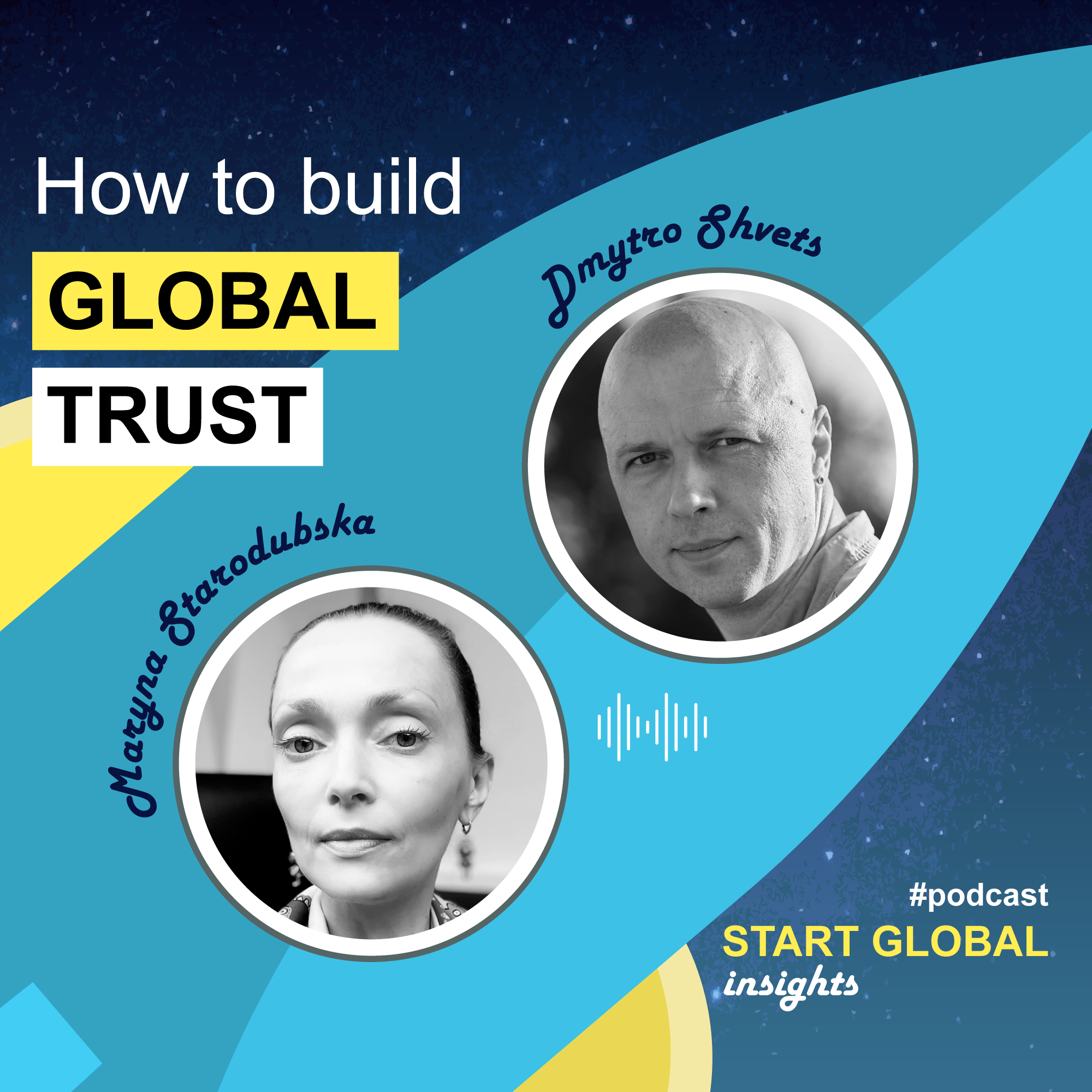
In this episode of Start Global Insights, Cross-Cultural Interaction Consultant and author Maryna Starodubska provides a holistic framework for understanding other cultures. She shares tips on how to understand other cultures and secure profitable international partnerships.
In this episode:
- The crucial difference between a Trust Loan and starting from zero.
- Why and where your Job Title may be the most important part of your pitch.
- How expressing Passion can be seen as either professionalism or incompetence in different countries.
- The role of Generalized Trust and the Trust Radius in market selection.
- Why seeking the “easy” market is the wrong strategic thinking.
Listen to the full episode at Apple Podcasts, Spotify and YouTube Music.

The Anatomy of Trust (Generalized Trust & Global Trust Radius)
To understand how to build trust in a particular culture, you need to start with the concept of generalized trust. This is measured by the ratio of trust given to the ingroup (family, friends, colleagues) versus the outgroup (strangers).

However, this number doesn’t tell the whole story. The more critical metric for Trust Building in Global Business is the Global Trust Radius, which measures how wide the circle of potential trust is for outsiders.

For example, in the U.S., the trust radius is a wide 50%. While Americans may not be very trustful at the beginning, you can take certain steps to open that circle. In contrast, China’s trust radius is a narrow 25%. This means the radius adjusted trust is actually lower than in the U.S. Despite the high overall trust level, it is significantly harder and takes much longer for an outsider to get inside that circle. This insight directly impacts your market entry time and budget, determining how much you must allocate for travel and relationship-building and for how long.

In Some Cultures You Get a “Trust Loan” – In Others, You Start at Zero
In high-trust societies like those in Scandinavia and the Baltic States, you are often given “advanced trust” at the beginning of a relationship. Think of it as being given a “trust loan”—you start with a positive balance that you must then maintain through your actions and reliability. As long as you don’t drop the ball, the trust will grow.
The opposite is true in the Middle East, Latin America, Asia, and Eastern Europe. In these cultures, trust is not advanced. You start with a balance of zero. To build a relationship, you must invest significant time, physical presence, and resources to earn trust from the ground up. There are no shortcuts; as Maryna notes, “there’s no way you can gain trust through correspondence. You need to go there. You need to meet people. You need to socialize with people.” Understanding whether you need to maintain a loan or build from scratch is critical for setting realistic timelines and deciding whether your initial outreach can be digital or requires an immediate, in-person commitment.
Your Job Title Can Open Doors – Or Keep Them Firmly Shut (Power Distance)
In some parts of the world, what you have to say is less important than who you are. This concept, often analyzed through the Cultural Dimension in Business known as “rank sensitivity” or “power distance,” measures how comfortable a culture is with inequality in status and authority. In low power distance cultures like those in Scandinavia, a department leader or even a high-level specialist can successfully initiate contact and hold meaningful discussions.
However, in high power distance culture (prevalent across Asia, Africa, and Eastern Europe) you had better be the Founder or CEO if you want to be taken seriously in initial talks. Ukraine, for instance, has an extremely high power distance score. Understanding this dictates the strategic decision of which executive’s time must be exclusively committed to a new market entry to ensure credibility.
Your Passion Can Be Perceived as Professionalism Or a Lack of It
The way you express emotion can be your greatest asset or your biggest mistake, depending on where you are. Cultures can be divided into “neutral” and “affective” when it comes to professional intercultural communication. In neutral cultures like Germany, Japan, the U.S., and the Nordic states, emotions are expected to be controlled in business settings.
“emoting too much in a serious context… in cultures like this is perceived as lack of professionalism.”
In these environments, showing frustration or even extreme passion can damage your credibility and derail a negotiation. Conversely, in affective cultures like Ukraine, Italy, Spain, and Turkey, expressing emotion is a vital tool. It is used to signal trust, establish a connection, and show a willingness to cooperate. If you maintain a controlled, neutral demeanor in an affective culture, you risk being perceived as disinterested, suspicious, or aloof. This Cultural Dimension in Business directly informs your negotiation strategy and how your team must present itself to either build rapport through passion or demonstrate credibility through composure.
The Same Gesture Can Have Opposite Meanings
Social norms that seem straightforward can carry vastly different meanings across cultures. Hospitality is a perfect example. In the Caucasus region, treating a potential partner to a good restaurant and ensuring they are well taken care of is a matter of basic politeness. It is a prerequisite for any business discussion and has nothing to do with a commitment to a deal.
In a country like Ukraine, however, that same level of hospitality is a product of trust, not a prerequisite for it. For a Ukrainian businessperson, extending a warm invitation is a “token of my trust” that comes after a relationship has begun to form. Misreading these signals can lead to prematurely allocating resources based on perceived goodwill or, conversely, withdrawing from a promising market due to a perceived lack of interest.
There’s no “Easy” country in terms of culture
When planning a global expansion, the ultimate takeaway is that there are no “easy” cultures to enter, only different sets of challenges. In a surprising twist, cultural analysis shows that Ukrainians have more in common with people from Colombia and Argentina than with those from a neighboring country like Poland. Geographical proximity does not equal cultural familiarity.
Instead of searching for an easy market, you must perform a cost-benefit analysis. The greater the cultural distance, including factors like risk aversion (Uncertainty Avoidance), the more it will cost to re-engineer your processes, from management to motivation. As Maryna Starodubska puts it, “bridging cultural divides is an investment.” The question isn’t whether your next market will be easy – it won’t be. The question is: is the opportunity lucrative enough to justify the investment in bridging the cultural divide? This is essential to master your overall Global Market Entry Strategy.
Methodologies for Understanding Cultures
To conduct your analysis, leverage evidence-based resources from cross-cultural science. These are the models and authors mentioned in the episode that provide frameworks for understanding cultural dimensions:
- Geert Hofstede.
- Fons Trompenaars.
- Michele Gelfand.
- Edward T. Hall
- Shalom Schwartz
- Inglehart–Welzel
By utilizing these methodologies, you can move beyond stereotypes and ensure that you are building real, lasting, and culturally sensitive international bonds.
What is the minimum advised to research for a successful market entry? Listen to the full episode.
Subscribe to The Start Global Insights podcasts
Don’t miss the opportunity to get insights about business cultures of different countries. Subscribe to the Start Global Insights podcast on all major platforms, like Apple Podcasts, Spotify and YouTube Music.