Master US Business Culture and Negotiation: A Practical Guide from Harvard Professor
Episode 28. Start Global Insights – podcast for exporters.
When entering the United States market, foreign exporters often face distinct communication norms, fast-paced decision-making, and high expectations for clear value propositions.
In this guide, we synthesize core insights from Linda Netsch – Lecturer at Harvard Law School, Stanford Law School, and UCU Business School in Ukraine, General Manager at FLEX by Fenwick, and Founder of Align Consulting. Drawing from her experience in Silicon Valley, executive consulting, US Army and global dealmaking, this article outlines how international business leaders can prepare for and win B2B negotiations in the US.
Listen to the full episode at Apple Podcasts, Spotify and YouTube Music.


Key Takeaways
- US Business Culture Is Fast and Direct: Surface small talk like “How are you?” functions as a polite greeting rather than an invitation for personal detail; negotiations quickly pivot to facts, legal terms, and price.
- Preparation Requires Mapping Interests: Effective pre-negotiation planning involves explicitly writing down the underlying interests, alternatives, and standards for both your company and your counterpart.
- Success Demands Empathy and Assertiveness: Winning deals requires balancing empathy (demonstrating you understand the counterpart’s perspective) with assertiveness (defending your own interests and boundaries).
- Compete on Value, Not Just Price: Foreign exporters win US market share by offering reliability, predictability, and emotional alignment rather than attempting to undercut low-cost global competitors.
- Short-Term Tricks Cause Long-Term Damage: In an interconnected global economy, transactional trickery harms business reputation; successful dealmaking focuses on sustainable, repeatable value creation.
- Control Emotions with Strategic Pauses: Using neutral phrases like “Interesting” or calling timeouts helps negotiators suppress fight-or-flight responses and stay focused on strategic objectives.

What Are the Key Cultural Traits of US Business Negotiators?
Understanding American business culture starts with recognizing that the United States encompasses multiple distinct regional micro-cultures. Negotiating a tech deal in Silicon Valley involves different dynamics than closing a manufacturing agreement in the Midwest or a corporate deal in Texas. However, several overarching communication patterns unify US business practices.
First, direct communication is standard. American business professionals generally move quickly from initial pleasantries to core commercial facts, figures, contract terms, warranties, and pricing. A common cultural misunderstanding for foreign exporters involves casual greetings. In the US, questions like “How are you?” serve as conversational placeholders equivalent to “Hello,” rather than inquiries into personal well-being.
Second, relationship building occurs alongside business discussions rather than strictly before them. While social dinners or sports events exist in US corporate culture, negotiators assume that formal meetings are reserved for practical problem-solving. Exporters should approach US counterparts with clear data, structured proposals, and direct explanations of product value.
How Should Exporters Prepare for B2B Negotiations in the US?
Systematic preparation is the single most critical factor in negotiation success. Many sales executives rely on informal mental notes, but effective dealmakers use structured frameworks to map out the negotiation landscape before entering the room.
1. Distinguish Positions from Interests
A position is what a party says they want (e.g., “We demand a 20% price discount”). An interest is the underlying motivation behind that demand (e.g., “We need to protect our profit margin against inflation” or “I need to demonstrate cost savings to my board”). When preparing, write down explicit lists of your interests and your counterpart’s interests. Look beyond money and credit – consider factors like creative control, risk mitigation, and internal stakeholder management.
2. Identify Alternatives (BATNA)
Determine your Best Alternative to a Negotiated Agreement (BATNA) – what you will do if talks break down. Simultaneously, evaluate your counterpart’s alternatives. Knowing each party’s walk-away options reveals where true bargaining power lies and prevents accepting unfavorable terms out of desperation.
3. Establish Objective Standards
US buyers rely heavily on objective criteria to justify purchasing decisions. Gather market data, legal precedents, quality certifications, and industry benchmarks. Presenting independent data transforms negotiations from a battle of wills into a collaborative effort to meet recognized standards.
4. Highlight Hidden Non-Price Value
Exporters often make the mistake of competing strictly on price. However, US companies frequently prioritize supply chain stability, product quality, and communication transparency over the lowest price point. For instance, Canadian and US buyers regularly select European manufacturing partners over cheaper alternatives because delivery predictability and shared operational norms reduce long-term business risk.
How Do You Balance Empathy and Assertiveness in International Deals?
Negotiation performance relies on managing two distinct interpersonal dimensions: empathy and assertiveness.
INSERT IMAGE
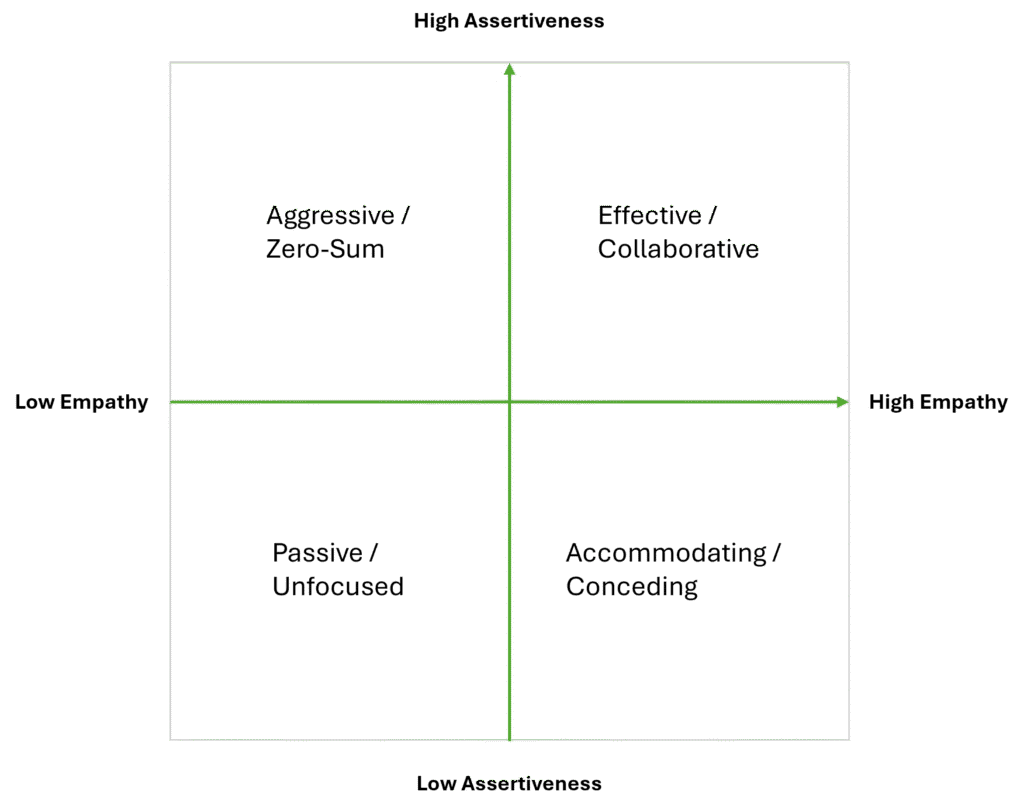
- Empathy is the capability to understand the counterpart’s perspective and communicate that understanding back to their satisfaction. It does not mean agreeing with their demands, but proving that you comprehend their constraints and goals.
- Assertiveness is the ability to advocate clearly for your own interests, requirements, and operational boundaries.
Negotiators who lean heavily on empathy without assertiveness risk making unnecessary concessions. Conversely, highly assertive negotiators who lack empathy create friction and alienate potential long-term partners. Successful dealmakers continuously monitor which “muscle” to deploy. When facing aggressive tactics, strengthen your assertiveness; when exploring complex options or resolving misunderstandings, leverage empathy.
How Can Exporters Manage Conflict and Emotional Triggers?
High-stakes international talks often involve tension, tight deadlines, or unexpected pushback. Emotional reactions trigger fight-or-flight impulses that impair rational decision-making. Negotiators can use concrete psychological tools to stay in control:
Pre-Identify Hot Buttons:
Recognize what counterpart behaviors set off negative reactions (e.g., interruptions, aggressive bargaining, broad accusations). Anticipating these triggers reduces their emotional impact during live discussions.
Distinguish Intent from Impact:
A counterpart’s statement may have a negative impact on you, but their underlying intent may simply be bad phrasing or cultural misunderstanding rather than deliberate hostility.
Use Neutral Pause Words:
When confronted with unreasonable demands or harsh feedback, respond with neutral statements like “Interesting” or rephrase their statement back to them as a question. This response provides valuable time for your analytical brain to evaluate the situation without escalating conflict.
Call Timeouts:
Taking a short break allows blood pressure to normalize and gives teams space to recalibrate strategy away from the bargaining table.
Practical Actionable Negotiation Checklist for Exporters
Use this step-by-step checklist before and during your US market entry negotiations:
- Research the Decision-Makers: Review social media profiles, professional backgrounds, and company news to identify counterpart priorities and organizational roles.
- Document Both Sides’ Interests: Write out a two-column list detailing your primary goals alongside your educated guesses about their key motivators.
- Define Your BATNA: Establish clear, viable walk-away alternatives before setting pricing or contractual limits.
- Gather Supporting Benchmarks: Compile independent market research, industry pricing data, or compliance certifications to support your proposals.
- Identify Unique Value Drivers: Outline non-price advantages, such as delivery timelines, customer service responsiveness, values alignment, or superior product durability.
- Prepare Pause Strategies: Agree internally on signals for calling timeouts or using neutral phrasing when talks become tense.
- Establish Post-Negotiation Feedback Loops: Request feedback after failed or completed negotiations to continually refine your market approach.
Subscribe to The Start Global Insights podcasts
Don’t miss the opportunity to get insights about business cultures of different countries. Subscribe to the Start Global Insights podcast on all major platforms, like Apple Podcasts, Spotify and YouTube Music.
Optimize Your Market Entry Strategy
Expanding into the United States requires combining competitive product offerings with refined international negotiation tactics. By preparing systematically, focusing on long-term interests, and balancing empathy with assertiveness, foreign exporters can establish profitable, lasting US partnerships.
Frequently Asked Questions (FAQ)
The most common mistake is focusing exclusively on price discounting rather than communicating total value, quality, and supply chain reliability. Additionally, foreign executives often misread American directness as aggression or spend excessive time on formal small talk instead of presenting structured business facts and contract terms.
US buyers evaluate options based on objective standards, total cost of ownership, risk reduction, and regulatory compliance. They expect concise proposals, data-backed claims, clear warranty terms, and predictable delivery schedules that fulfill immediate operational needs.
Interest-based negotiation, developed through the Harvard Negotiation Project, focuses on identifying the core motivations and needs of both parties rather than locking into rigid bargaining positions. This approach aims to create joint value and craft enforceable agreements that satisfy both sides long-term.
Avoid bringing up controversial political, historical, or social subjects during business discussions. If a sensitive topic arises, maintain professional curiosity by asking broad, non-judgmental open questions rather than asserting personal opinions or taking defensive stances.
US importers frequently prioritize supply chain predictability, low defect rates, speed of communication, and shared business ethics over lowest unit costs. Sourcing cheaper products often introduces hidden risks, long delays, and quality control issues that outweigh initial price savings.